
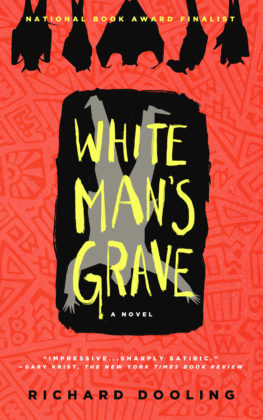
A Novel by Richard Dooling
1994 National Book Award Finalist
New York Times Notable Book of 1994
Read Chapter One of White Man’s Grave
Review Excerpts
“A bravura display of satire . . . Dooling evokes the humane checks and balances of a deep world: the logic, you might say, of its magic.”– Richard Eder, L.A. Times.
“The book is absolutely astonishing; I am a Richard Dooling fan for life.”–Phillip M. Margolin, author of Gone, But Not Forgotten and After Dark.
I spent seven months in Sierra Leone in the early 1980s and thoroughly researched everything I’d heard about over there. Unfortunately the books I used are found only in libraries.
White Man’s Grave Background Books:
- The Mende Of Sierra Leone, By Kenneth Little;
- Mende Religion, By Anthony Gittins;
- The Springs Of Mende Conduct and Belief, By Harris Sawyerr.

{ 21 comments… read them below or add one }
Dear Janice:
I’ll find out. I know just the person.
Thanks,
RD
Hi Richard!
We’ve had our Book Club meeting, but I am still interested in finding out about the Leopard and Baboon Societies depicted in the dances that I saw. Janice Trubitt
Hi Richard!
Just returned from a mission trip to paint a secondaray school in Kabala, Sierra Leone. Picked your book for our book club monthly meeting because the scenes of Freetown, use of Krio language, descriptions of food, customs and beliefs, and life style were so accurately portrayed. One day the village of Kabala presented a Culture Day of song and dance. Women painted themselves with spots representing the leopard and another lady had on a brown outfit representing the baboon. Can’t find any information about this. Could you explain the story for me? Janice
I have read it twice and recommended it my friends and family. It has been loved by all. I agree the film needs to be made. I hope you find the writer who can breathe life back into the project. In the meanwhile you could suggest to whomeve has the rights that the book be re-released on a more current audio format. The cassettes are going for outrageous money right now. White Man’s Grave should be on iTunes. Better yet it should be available for free download on some p2p network. Better that than the decaying analog tape that no one can buy.
Ah, the scrivener Dooling and his adoring minions! Sorry to have taken so long to check in as I was occupied saving some sliver of this world. Hard work that. Truth be told I’ve expended more energy saving myself while trying to spare the world any further harm.
So, Mr. Ed… palm wine, eh? Well, the Brits seemed most concerned with distilled spirits which was fine by most rural Sierra Leoneans (and almost every citizen save the Krios claims roots to some village in the provinces) who tapped palm wine directly from the tree. No processing necessary (although palm wine can be distilled to make a powerful spirit called ‘omole’). The pure palm wine, unadulterated by water and sugar by unscrupulous sellers, is still proffered with the hallowed claim ‘from god to man’. By the way, when negotiating for a draught of ‘fresh’ one can query the seller on the beverage’s purity by citing the old reggae standard, ‘many rivers to cross’. If he smiles, the jig is up. Should he vigorously deny check out the status of the ‘tumbu’ larvae floating on the surface. Live and active, the better the chances of pure ‘kadams’. If the the larvae are missing or doing the deadman’s float it is likely that the wine has been tainted. You may still opt to imbibe but at least you’re informed of the gastrointestinal risks introduced with the water and gain some leverage in the negotiations.
Many are the vessels (plastic mug, tin can, calabash, cow horn, bamboo cup, and so on) that carry nature’s nectar to parched throats. Just be sure that when the container is empty you turn it on its side. Otherwise, another sot seeking refreshment will have her hopes needlessly dashed thinking that some wine still remains in the upright vessel. Palm wine credo – “a dead man should not be standing” (Krio: ‘daiman no foh timup’).
Lahai Hindowa
Thanks, Ariah. I saw one in the New York Times recently about a deaf Peace Corps Volunteer that looked interesting.
Here is the article: Cochlear Implant Supports an Author’s Active Life, and here a link to The Unheard: A Memoir of Deafness and Africa.
I’ll post again after I read it.
RD
Mr. Dooling,
I just read your book and thoroughly enjoyed it. It was quoted and recommended in another book I had read at someone’s recommendation: Serving with Eyes Wide Open.
Anyways, just wanted to stop in and say thanks.
Mr. Dooling,
A couple of years ago I listened to White Man’s Grave on tape while going about other business. The scene where the insurance man goes to confession is one of the funniest I’ve ever read…and I’m sure my fellow shoppers at the supermarket were wondering what prompted my raucous laughter. You have combined a black satire, realism and a tasty modern supernaturalism to make “my kind of book.” I recommend it to everyone!
~ Helden Kline
I loved White Man’s Grave. Re the conversation on denying insurance claims, you might find these experiment by two excellent social scientists interesting.
http://tinyurl.com/m4mn4
Paul Brest
Ted,
White Man’s Grave was optioned in the late 90s by Lawrence Bender, whose deal was with Miramax at the time. I wrote a draft for them, the option was not renewed, I moved on, and the White Man’s Grave film rights reverted to me.
I still think it could be a feature film, but I am older and wiser now and believe that it might require the aesthetic distance and objectivity that another writer could bring to it. I was told repeatedly that it’s hard to develop your own novels into screenplays. Being headstrong by nature, I didn’t listen. Thanks for your interest.
Of the three countries you mentioned, I visited only Mali, though I heard time and again great things about Cameroon. Would love to visit.
RD
Richard,
I was talking with a friend last night about the movie Volunteers (1985, with Tom Hanks and John Candy)–and how it was a missed opportunity to capture the comic potential of the Peace Corps experience. Both of us had been PCVs in Africa (me: Cameroon, my friend: Guinea and Mali).
I recalled thinking that White Man’s Grave came as close as anything I’ve ever read to capturing the my feelings about West Africa–my love for the place, in spite of it’s sometimes maddening tendencies–maddening to an outsider, that is.
So, what ever happened to the movie prospects for your book?
Karen,
Thanks for your kind comments. I’ll see if I have a speech or interview somewhere with “study-guide”-like questions or answers that I could post. But I won’t be able to post until Monday, probably.
In the meantime if you can find the story BUSH PIGS, originally published in The New Yorker, and available in audio on one of the Symphony Space Selected Shorts, it will grab you at this point in your journey. It’s kind of a cult favorite of Returning Peace Corps Volunteers and other expats. It’s much more exciting in audio than in print, and is often available in libraries. There’s a link to purchase above. The other stories (by other authors) are also quite good.
rd
I have recently returned from four months in Kenya as a health care volunteer. My mentor and African guide was an American doctor.
It was an amazing journey! Each day my emotions were spent. The people are so full of spirit. It was difficult to leave. I have never felt so alive!
A book club member suggested your book. It clarified so many things that I had experienced. Your descriptions were palpable.
Is there a study guide and or questions for discussion? We meet soon and it would provide structure for our meeting.
Thank you for writing this book. I plan to buy a copy for my personal library as well as suggest it to some colleagues who will be in Africa this year. I plan on returning in 2007.
..Karen
Hello Mr. Dooling,
I’m a professor at Wesleyan University (I’m an 18-c French lit specialist, truth be told) and I wanted to tell you that I have taught your book twice in a seminar that is entitled “Africa in the European Imagination.” It is a terrific “capstone book” for the course since it allows us to think through many questions that came up during the course of the semester. In case you are intersted, we read Lopez and Pigafetta on the Congo (1590), Leo Africanus, Cadamosto (on Senegal 1450), Bernardin de Saint Pierre (on Mauritius), Hume, Diderot, Kant, Defoe (Cap’n Singleton) and Maupertuis (on the Albino)… and then we read you since it allows us to look at the various contemporary “readings” on Africa — be it Boone or Lewis etc.. — from an almost allegorical p.o.v. It is also terrific b/c it flips back and forth between the emic/etic, the stuff of anthropology . . . which is relegated to toilet paper in your book !
Thanks so much for writing this..
All best,
Andy Curran
yeah, I saw it. Tim’s has a great book out: “The Undercover Economist”
Good article on Cameroon, in ReasonOnline, entitled, “Why Poor Countries Are Poor” by Tim Harford
thanks for the reply. well, the best way to drink palm wine is from the calabash (and you probably saw that too). Great book. I am keeping my copy for good; it is siting next the “poisonwood bible”
Ed,
The book is dedicated to Michael O’Neill, but I used his African name. He is not still in Africa, but travels there often. I have invited him to comment here himself, but I fear that he is currently traveling abroad, as his work frequently requires him to do. I’m sure we’ll hear something from him here upon his return.
As for palm wine, I saw it poured and drank from every conceivable container while I was there. Also, I don’t think I ever heard that the British banned palm wine, but Mike O’Neill may know something of this. I know the British outlawed witchcraft and Leopard or Baboon Society business, which were punishable by death, or so I read in the texts I consulted.
Richard Dooling
So what happened to Mike 0′Neill? Is he still in Africa? I realized that he wasn’t acknowledged? Also, I know the book is largely fiction, but did Mike face similar troubles — as “Michael” — during his time in S. Leone?
At the end, Boone and Michael drank some palm-wine out of a kerosene jar/container (I think), which seemed out of the ordinary. Well, I was told that during the colonial days, the British banned the production and sale of locally distilled alcoholic bevarage (such as the palm-wine), to eliminate the competition with the imported gin/rum, etc. To get around this ban, palm-wine distillers transported their produce in such jars/containers. But it was still a very dangerous business… much like today’s war on drugs.
Dear Ed:
I was in Sierra Leone from October of 1981 to April of 1982 visiting a good friend, who was a Peace Corps volunteer in the village of Mbundobu, just west of Bo. I did not make it to Ghana, though I was told the countries share many cultural similarities. I loved my time in Africa (except for malaria
When I left, I traveled overland mostly, except that the borders were closed around Sierra Leone, so I flew to Bamako, Mali, then to Upper Volta (now Burkina Faso), Niger, Algeria, and Tunisia, from which I disembarked to Italy.
I traveled primarily by “hitchhiking” or arranging to pay for rides on trucks across the Sahara. The first part of White Man’s Grave, describing the how and why of Boone’s going from Indiana to Paris to Sierra Leone follows closely the logic and progression of my own trip. My friend, Mike O’Neill, and I had planned to travel in Europe, but then he could not leave Sierra Leone for various reasons, and so I traveled there, from Paris.
Would be happy to answer any other questions.
Richard Dooling
Hi richard,
I read this book, twice. please send me an email, if you can. there are so many things I would want to talk about… the book,
your experiences in S. leone, its beliefs, etc. I am Ghanaian.
cheers,
Ed