
Survival Of The Smartest: Will Geeks Inherit The Earth?
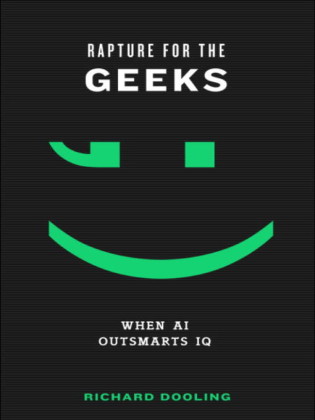
Media Coverage of Rapture For The Geeks:
- Sunday New York Times Op-Ed, “The Rise of the Machines,” by Richard Dooling.
- Jeremy Lott reviews Rapture For The Geeks at Ars Technica.
- The Wall Street Journal Digital Network.
- The New York Observer, Digital Doomsday, by Gillian Reagan.
- Thomas Edsall discusses Man Versus Machine and Richard Dooling’s “New York Times Op-Ed, The Rise of the Machines,” at The Huffington Post.
- Ferris Jabr puts Rapture For The Geeks on Pyschology Today’s bookshelf.
- Daniel Kennelly discusses Rapture For The Geeks, Richard Dawkins, and atheist-baiting at Doublethink Online.
- David Takami reviews Rapture For The Geeks in the Seattle Times.
- The Independent, Keen On New Media: The New Master of the Universe, by Andrew Keen.
- Bibliolicious.com.
- Marketplace host Kai Ryssdal interviews Richard Dooling on American Public Media’s Marketplace program.
- Listen to Richard Dooling discuss Rapture For The Geeks on Coast To Coast Radio with George Noory, Monday, September 29th, from 11pm-2am Pacific.
- Publisher’s Weekly review of Rapture For The Geeks.
Your User Profile
(Excerpted from Rapture For The Geeks, by Richard Dooling.)
User, noun. The word computer professionals use when they mean “idiot.” –Dave Barry
There are only two industries that refer to their customers as “users.” –Edward Tufte
It’s time to launch the web browser of your imagination and surf the undiscovered future of technology, but first a few questions to assist you in formulating your user profile.
Are you addicted to your computer? To the Internet? To e-mail? To your Treo, iPhone, or CrackBerry? To computer gaming? Or maybe to computer programming? Perhaps you’re not addicted (and you don’t overeat or drink too much or take drugs), maybe you just like to configure and personalize your favorite software, until it does just what you want it to do, just the way you want it done. Do you tweak the options and widgets and custom codes on your Blogspot or your WordPress weblog for hours on end, until your little corner of the Internet is “clean” and well-designed? Have you logged onto the MySpace at 2 A.M. asking, “Help! I can’t get my marquee scroll generator to work! How can I make my table backgrounds transparent, the border invisible, my photos appear to hover, and my hyperlinks underlined and 12-point Garamond?” Are you the type who customizes menus, macros, and toolbars for hours at a time, sometimes for more hours than you’ll ever spend actually doing the task you had in mind when you started the program?
Here’s the big question: Do you ever feel that you once used computers and computer programs as tools to get a specific job done, but lately you wonder if Dave Barry was onto something when he wrote: “I am not the only person who uses his computer mainly for the purpose of diddling with his computer.”
Then again, maybe you aren’t addicted to your computer. Maybe instead you hate your computer. But somehow, even though you detest the *&^%$@!# thing, you spend more time messing with it than your tech-loving, overclocking geek friend spends messing with his. Maybe you hate it even more when your tech-loving geek friend stops answering your user-in-distress emails, because then you wind up on the phone all evening with a woman in Bangalore, asking her how to make your spyware-hijacked Internet Explorer web browser stop loading the Play-Strip-Poker-With-Hot-Young-Co-Eds website before your wife gets home and wants to check her e-mail.
Does your handheld sometimes feel like a prosthetic device containing your own personalized sixth sense? Is it a brain extension, with an extra, palm-held visual cortex for displaying YouTube videos? When it’s gone, or broken, or not charging properly, are you bereft? Adrift? Are you a victim of what Harvard neuropyschiatrist Dr. John Ratey calls “self-inflicted acquired attention deficit disorder,” because you compulsively reach for the thing, even when you don’t want to? Were the editors of the New York Times talking about you and your gadgets when they observed (on iPhone day, 29 June 2007): “The real test of each new apparatus is how easily it is ingested and how quickly it becomes part of the user’s metabolism. All you have to do is watch a 9-year-old teaching her mother how to text to understand the truth of this.”
When you’re in a panic to make an appointment and you can’t find your car keys or your billfold or purse, do you instinctively begin formulating search terms you might use if the real world came with Google Desktop Search or a command line interface? Whoever created the infinite miracle we glibly call “The Universe” is surely at least as smart as the guys at Bell Labs and at UC Berkeley who made Unix. The Unix creators wisely included a program called “find,” which enables you to instantly find any file on your system, especially any file in your “home” directory. Another command called “grep” enables you to find any line of text in any file on your entire system. Mac OS X uses Spotlight to do essentially the same thing, with some spiffy visuals added; even Microsoft finally included “Instant Search” in Vista.
So why can’t the Creator of the Universe come up with a decent search box? Why can’t you summon a command line and search your real-world home for “Honda car keys,” and specify rooms in your house to search instead of folders or paths in your home directory? It’s a crippling design flaw in the real-world interface. And while we’re at it, how about an UNDO button? Wouldn’t that come in handy in the real world? Especially if you just totaled your car or contracted a venereal disease? Why can’t you just hit Ctrl-Z or click on the swirly little UNDO arrow icon and put everything back the way it was before? If only your mouth came with a backspace key.
If you have one of those days where all of life seems corrupted, broken, full of error messages and warnings, and the kids are all out somewhere performing illegal operations, buffer overruns, segmentation faults, and destabilizing the system. On those days, what you need is called: Real Life System Restore. Restore Your Life To Last Known Good Configuration?
Want to read more? Try Genesys: EULA For The Universe. Have fun!
(Excerpted from Rapture For The Geeks, by Richard Dooling.)

Pingback: THE FUTURE OF THE FUTURE – THIS IS HOW IT WILL BE? EVERYTHING IS POSSIBLE « Worte, Zeichen, Bilder
Pingback: Python On XP: 7 Minutes To “Hello World!”
Richard,
Thanks for taking a topic that I’ve read, talked and thought about for almost 10 years now and doing a much better (and more entertaining) job covering it than I ever could.
Pingback: Rapture Updates
Terrific read, Mr. D., although my love of your novels makes me sympathize with your agent’s comment in the acknowledgments. (And it’s semi-pro love, as I’m a writer manque.)
One correction: the totemic icon of the SubGenius is J.R. Bob Dobbs, not R. Bob. (225, note)
Thank you so much for the hours of enjoyment and thought you’ve provided over the years.
And I’ll bid you no “Hail Eris!” but that which we’d say at my Jesuit school, AMDG, MF.
just as a heads up..
it might not actually be a coding error on ur part. might have something to do with the way it has be formatted. idk
but the same thing happened with the emily dickinson poem, ‘=’ was used instead of ‘==’. found in the if statement in the hold() function.
maybe there is some weird auto formatting going or something… but every time there should by ‘==’ there is only ‘=’.. very strange
Dang! Thanks for catching that, Dylan. Will fix for trade paperback edition.
RD
wow amazing book. read it 3 times.
one problem.
Code Box 5:… if you re print the book. fix the coding error
u used the assignment operator instead of the equality operator :O! broken code
haha still an amazing read though
Entertaining read but FYI your assertion on p. 71 ‘Modern computer science had lots of fathers and no mothers’ is wrong — Admiral Grace Hopper was assuredly a first-class mother. Look her up.
Pingback: Au secours, mon livre est sous licence Microsoft ! | Alterdigue
Dear Dennis:
Two different stories. Here’s Asimov’s Final Answer:
http://www.multivax.com/last_question.html
Here’s Fredric Brown’s Answer:
http://www.moonbuggy.org/archive/2008/01/02/fredric-brown-answer/
Mr Dooling:
I just bought a copy of “Rapture”, and noticed the story you mentioned in section 1.2 regarding creation of “God”. I think the story is actually by Isaac Azimov, called “The Final Question”. But you do describe its punch line as best I remember. I suppose it is possible F. Brown did a similar story, but I don’t remember reading it.
Thanks,
DHQ
Pingback: Richard Dooling » Blog Archive » If Microsoft’s EULA Applied To Books
Pingback: Richard Dooling » Blog Archive » Mothers Against World Of Warcraft
Credit Default Swaps and a doomsday metaphor
Maybe we need some credit default derivatives for Main Street. Why should Wall Street be the only recipient of bad credit protection? That way when mortgage companies and brokers sell deceptive products to the consumers the seller pays. How about that?
All the wishful thinking aside, I heard that Warren Buffett termed these derivatives toxic ‘weapons of financial mass destruction’. A op-ed contributor Richard Dooling to The New York Times and author of ‘Rapture For The Geeks: When AI Outsmarts I.Q.’ argues that the geeks who created these ‘evolutionary algorithms’ that transfer the credit exposure to the seller, can be so complex that no one may ever understand where the 62 Trillion dollars is, except maybe the computers. If this house of cards falls, look out!
I can sympathize with Dooling’s comparison to a 1981 documentary called ‘The Day after Trinity’ by Theoretical physicist Freeman Dyson who decried the seductive power and glitter in creating nuclear weapons and a kind of arrogance that could lead to the end of mankind. It gives people an illusion of illimitable power. I can also agree with Dooling that the Wall Street geeks likely succumbed to a similar and irresistible lure of ‘illimitable power’. Dooling also mentions Physicist Dyson’s son now some 30 years later George Dyson and author of “Darwin Among the Machines”. George Dyson is a historian of technology, and according to Richard Dooling’s New York Time article “a book that warned us a decade ago that it was only a matter of time before technology out-evolves us and takes over.” It appears that George Dyson laments a time in history when funds transferred by means representing proof positive that gold existed somewhere to back it up. He reported that that was good enough for 600 years as if today technological efficiencies and computers are unsustainable.
As you may have guessed by now, I may agree with Richard Dooling’s metaphor comparing the Manhattan Project to today Wall Street melt down and Freeman Dyson’s and George Dyson’s concerns, but I don’t entirely agree with their doomsday scenario for technology and the human race. Although, I believe that their scenario could come true, I would like to approach the subject more hopefully and optimistically.
If they really believe that risk in the past was any better, then I suggest that we cordon off a Western state in America and surrounded it with an electrified like Jurassic Park fence, then we could place them behind it without any of today technologies, and just see how long it takes them to come out. The fact is that the Earth is likely to be destroyed by many natural calamities aside from mankind himself. I could name many of them from space and on Earth itself, but why repeat what most educated individuals already know. The truth is that even if we regressed to a primitive time our life span would only be about 20 years, and even now, only about 100 years. So, to me, if one doesn’t preface a hopeful solution along with doomsday, then I’m disappointed.
Life is full of risk, and I’m not sure that there is ever certainty. The scientific ‘uncertainty principle’ was envisioned as far back as 1926. That principle is still honored in today science. Quantum uncertainty and lives uncertainties go along with the territory. I believe that the future is where we are headed and that only in the future is there hope. I comport with a saying that I heard recently from Hillary Clinton ‘if you don’t boom you’re buried.’
One of the primary fears that doomsday advocates continue to bemoan is AI artificial intelligence taking over the world. I believe that it could happen, but I’d rather believe that it wouldn’t. I believe that artificial intelligence will never be holistic without biological senses. We will merge and a new human hybrid will inherit the Earth. This hybrid will be powerful beyond the imaginings of today laymen…and most educated. My question is what will be the outcome for the human race. Out of some 6 billion people on Earth who will live and who will die? The outcome could look a lot like a religious prediction except for the process. A God like being could arise upon the Earth. Only this God like being comes from God like ideas and seeming imperatives buried deep within the original purpose of the universe itself. It’s as though the outcome is the assembly of a God that had always existed inside of nature.
Although I believe that this future is hopeful, and it’s where science and life are headed, I have many questions regarding the outcome. In that Judgment-day, will only the rich and powerful, partake? Will some six-billion (plus) human beings on Earth all equally partake? What about the terrorist, serial murderers, tyrants, slave owners; at present, will some two-hundred million slaves, partake? Will devious, dishonorable, loathsome, or just plan ignorant politicians, police, and military, partake (not all such individuals are dishonorable – too many are)? Will we consider simply remaking their brains so that they too can partake, or are some human beings simply beyond redemption? I would consider saving the poor, and one disenfranchised little 5-6 year old child that I saw on a PBS show about slave labor, and remove all her pain of the experience, improve her brain with the more perfect wiring of a genius, add omnipotence, and place her on the jury! Are the powers that we are creating so incredible and enormous that to remain primitive in our nature is simply unthinkable? I’m not formally religious, but do the words still ring true, “The meek, and pure at heart shall inherit the Earth”? ~Beaver
Truck driver/miner Web Page at GOOGLE Keyword ‘Dr. Warpenstein’ or ‘drwarpenstein.com’.
Bravo. That was a well done guest spot you did the other night on Coast to Coast AM. Indeed, one of the best.
Thanks for touching on so many interesting branches of the A.I. subject. Really enjoyed it.
I look forward to reading your book on the trains here in Tokyo (the belly of the beast as it were).
I haven’t read yours or Ray Kurzweil’s work yet, but judging from that interview, I’d be well served to do so, without delay. Sounds right up my alley.
Sincerely,
Rob Reilly
John-Christopher:
Mmm. I don’t recall George shorting me out. I thought he was gracious and accommodating. No matter how long those interviews run there’s never enough time to really develop an idea: That’s why we have books!
Thanks for listening. Oh, yeah, spikes aplenty from Coast2Coast.
Thanks again,
RD
Hey Richard, ya did great last night. Your natural intelligence pattern makes you a great ‘listen’ and — i am not sure what cutting edge thinking is any more — it’s all kind of s-t-r-e-t-c-h-i–n—-g as we near the SINGULARITY — but you convinced me that i need a reload!
But! (if i may) imo you shouldn’t ‘kiss ring’ quite so easily! You let GN short you out a couple times when i really wanted to hear YOUR view. Once you agreed with his (far more pedestrian) view, you couldn’t exactly contradict him. BE BOLD and BUTT IN. Practice “No George … ” “That’s interesting but i think….” Like that. Maybe you should watch the game tapes on youtube before going on.
By the way are you noticing any big spikes? — please report on your experiences for all your fans and competitors! I don’t think people realize how SUCKY the brilliant-book business is. What are your views? Will check back and hope to see your book soon.
best,
JCAD
I heard you on C2C and thought you’d appreciate this bit from the genius Douglas Adams,
Douglas Adams on technology:
I’ve come up with a set of rules that describe our reactions to technologies:
1. Anything that is in the world when you’re born is normal and ordinary and is just a natural part of the way the world works.
2. Anything that’s invented between when you’re fifteen and thirty-five is new and exciting and revolutionary and you can probably get a career in it.
3. Anything invented after you’re thirty-five is against the natural order of things.
Richard,
Just listened to you on Talk Radio. You are very interesting person and enjoyed your interview. I will definately check out your book.
Take Care,
Tonya McDivitt
I have to admit, I’m feeling something like rapture hearing there’s a new Dooling book on the way. It’s been quite a wait (tough on us impulsive types). Thanks for the good news.